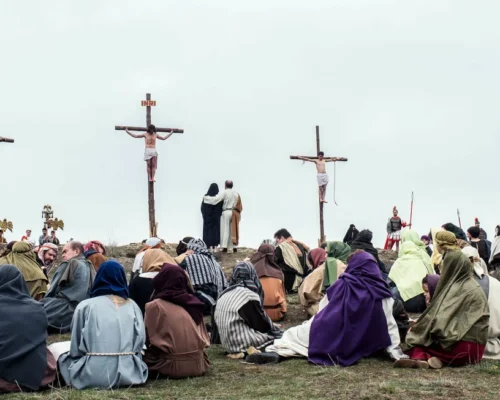
In three out of the four Gospels after the burial of Jesus on Good Friday, there is no mention of anything that happens on Saturday. Matthew talks about how the Jewish religious leaders, still manipulating Pilate, convince him to seal the tomb and place a royal guard around the entrance to the tomb for fear of the disciples stealing the body (which will become very important later as evidence for the resurrection), but other than that, not one of them talks about Saturday at all. There is just empty space. Honestly, like all other things in scripture, I think that’s on purpose.
I cannot imagine being one of Jesus’ followers following the events of Friday. Peter had denied even knowing Jesus three times, much less being His friend or follower. The rest of His disciples (sans Judas & John) were scattered throughout Jerusalem and the surrounding area, afraid to even show their faces for fear that what had happened to Jesus would be their fate next. John had stood by and watched as his best friend had been brutally murdered in one of the most cruel forms of execution the world has ever known. All of them were no doubt dealing with the trauma of what had happened in their own way.
After they laid Him in the tomb, they observed the Jewish custom of the Sabbath – and of course they did – because they were in fact, still Jewish. On the Sabbath (from sunset on Friday to sunset on Saturday) they weren’t allowed to do any work, or anything strenuous. They had rushed to get Jesus buried before sunset, and there would be more work to do, but not now.
So as the closest followers of Jesus sit idle and alone, I am sure they were not only replaying the events of Friday in their heads, but also the last three years. They had given up everything else to follow Him across the countryside. They believed that He was different from all those who had claimed to be the Messiah before Him. They had more than just His followers, they were His friends. And now that friend was gone. All the things He had promised seemed to be a lie. The things they had sacrificed seem now to have been in vain. They will have to go back to their families and their homes filled with shame and embarrassment. With death, there is always a finality – but this was more than just the death of a man – it was the death of a movement.
The reality of Saturday is, every single person, from Peter to Pilate, all the way to Caiaphas thought that it was over. Some were happy, others relieved, and even more were devastated. In those moments, nobody expected no body in the tomb come Sunday morning.
For those who have been following Jesus, while Saturday is usually a day of rest, on this specific Saturday, there is no rest for the weary. Grief, pain and sorrow fill the day in a soul crushing and life altering way. There is no empty space in their story, but there is one, in their hearts.